

Table of Contents
In the kitchen of mine, I initially go for Passion fruit jelly due to its bright and tropical feel, a real fruit preserved from just cooking of passion fruit juice, sugar, and pectin that becomes clear, spoon-able jelly of sorts. I am a lover of this balance between tangy and floral flavors; oftentimes I combine this spread with something sweet, using this marmalade as an ingredient in desserts or even some lovely sauces.
This valued clean flavor and versatility, with natural tartness, helps it set and prevents being overly sweet, which appeals to home cooks. I have presented it in toast and biscuits, standing between cakes, and brushing over pastries for shine and flavor. It is different from jams in that it employs strained juice, not pulp, thus providing a smooth and translucent finish. When made right with standard methods, it is shelf-stable, safe for home canning, with a pronounced scent, bright hue, long storage period, widely accepted for daily use and gifting.
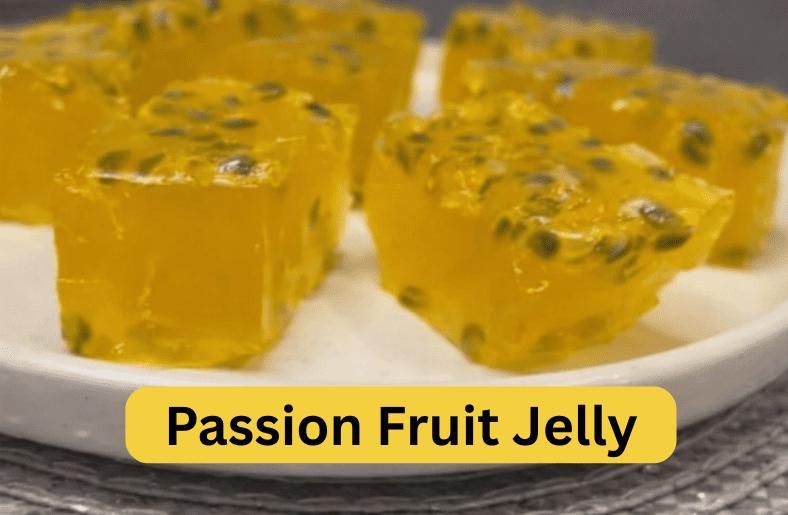
What Is Passion Fruit Jelly?
Starting with a taste that is sweet, balanced and sour at the same time, passion fruit jelly is a transparent, silky fruit spread prepared with the juice of the passion fruit, sugar, and pectin. The whole process is slowly cooked to obtain a strong, cuttable gel that has a shiny look and neat texture. Unlike jam or preserves, it has no pulp and no seeds, which gives bright color and a reliable set.
From my home canning experience, using commercial pectin ensures consistent, food-safe results because natural pectin can be unreliable. For best results, use fully ripe fruit or high-quality frozen juice, follow tested pectin ratios, and avoid reducing sugar unless using low-sugar pectin for its designed purpose.
It’s perfect for spreading on toast, biscuits, or English muffins, glazing cakes and pastries, or pairing with soft cheeses like cream cheese and brie, and even cheesecakes.
Ingredients Needed for Passion Fruit Jelly
The first step in my passion fruit jelly making process is always to use juice or fruit pulp. I either fresh or frozen pulp that is all drained off completely to obtain the seeds. This ensures that the jelly remains smooth while the unique tropical taste and natural acidity are preserved. I then introduce granulated sugar to the mixture to give it a clean sweetness along with proper gel formation and long-term preservation.
Reducing sugar might cause the passion fruit jelly not to set, hence I do not use it. The reason for this is the lack of pectin in passion fruit, so the addition of commercial pectin, whether it is in powder or liquid form, is a must for the obtaining of a reliable gel. I also depend on lemon juice, particularly bottled lemon juice, to harmonize the tastes, keep safe acidity, and get the exact pH.
Moreover, I add just a small quantity of water in order to make the juice concentration more friendly if the strong pulp is meant to be intense. For safety reasons, to achieve jelly stability, and due to the requirement of using precise measures, I weigh the ingredients since jelly-making is akin to chemistry. I do not use honey or non-sugar sweeteners except when the pectin allows it, and I use only the pectin brands that have been tested and follow their guidelines closely.
My combination of ingredients represents the best-practice standards of home-based jelly-making and canning since it not only cares for the right proportions, taste, and texture but also maintains the industry’s blessing.
How to Make Passion Fruit Jelly (Step-by-Step)
Making jelly from passion fruits at home is simply the classical jelly-making method (For other homemade canning and recipes Click on here) that relies on very accurate measurements, very high heat, and very perfect timing. I found out very soon that if one does not carefully follow each step and make the right decisions, then the results would be unclear, poorly set, texture, flavor and safety of preservation would be compromised.
First, concentrate on preparing passion fruit juice. When using fresh fruit, I take out the pulp, run it through a very fine sieve and finally remove the seeds. Frozen pulp must undergo a complete thawing process and subsequently be filtered. Utilizing the exact quantity of juice is of utmost importance, as the setting can be affected if the quantity of juice is either too high or too low.
In a large deep saucepan, combine measured juice with commercial pectin. Stir thoroughly before you turn on heat to prevent pectin clumping. Place the pot on high heat and stir constantly until the mixture reaches full rolling boil and continues to boil when stirred.
Next, add all granulated sugar at once. Right away, stir until all the sugar has been dissolved, and then put back to a rolling boil and boil extremely for exactly one minute, unless pectin directions say differently. This specific boiling period is essential for the right gel to be formed.
Take the pot off the heat and with a spoon, carefully remove the foam on top so that the jelly will be clearer when finished. Then pour the hot jelly into the canning jars prepared very quickly with ¼ inch of headspace, which is the recommended one, just like that. Clean the rims of the jars, put on the lids and bands, and use the standard jelly-processing times for boiling water bath processing of jars. After cooling, check the seals before putting them away. Accurate measurements and tested canning steps create shelf-stable passion fruit jelly.
Tips for Perfect Passion Fruit Jelly
Start smart by choosing ripe passion fruit with wrinkled skin and a strong aroma. In my own batches, this always gives higher flavor and balanced natural acidity. Work only with fresh pulp or strained juice; seeds can turn bitter if overcooked.
Next, always measure sugar and pectin with precise measurement. A correct ratio creates a reliable set. I learned early that reducing sugar without adjusting pectin leads to runny jelly. Check acidity as well. While passion fruit is an acidic fruit, bottled juice or diluted pulp may need a small amount of lemon juice for proper pectin activation.
During cooking, boil hard until a steady rolling boil that holds even when stirred, then keep briefly boiling. Overboiling causes a weak gel and dull flavor. Skim foam with early skimming for better clarity and shelf appearance without affecting food safety.
I always test the set using the freezer plate test or spoon test, never guessing. Clean jars, hot jars, and prepared jars with secure lids are the best way to prevent spoilage and protect texture and support long storage. Doubling jelly batches is not recommended because jelly chemistry is less predictable in large volumes.
In case your jelly is too runny or not thick enough, you can consult the guide on Fixing Jelly That Won’t Set, which describes very simple and easy to use methods to improve the texture without impacting the taste negatively.
Passion Fruit Jelly Variations
No doubt, sweetness, texture, and flavor can be effectively managed through the variations of passion fruit jelly without affecting the safety of the product. Usually, I stay with the same mixture—passion fruit juice, sugar, and pectin—and then do slight, though smart, changes which are still appropriate for canning.
For less thick offers, low-sugar passion fruit jelly uses low- or no-sugar pectin. In my opinion, the most important factor is to control the fruit-to-acid ratio in a way that the jelly can freeze neatly and be bacteria-free for the lifetime of the shelf.
My taste buds lead me to a less intense flavor sometimes, and then I prepare the jelly of passion fruit with honey that is a combination of sugar and honey. The jelly not only contributes soft floral notes as well as dexterous pectin management to ensure a firm set.
Passion fruit vanilla jelly can be a nice addition to dessert. The use of either vanilla bean or extract darkens tartness and provides a good match with baked goods or yogurt.
The zing comes from the passion fruit citrus jelly that combines the juices of lemon, orange, or lime which raises the acidity level and provides a more dependable gel.
Ginger, chili, or mint in very tiny quantities will give off heat, warmth, or fresh aftertaste to the drink, just let it infuse for a short time and do not decrease acidity level.
If you like to do some creative experimentation with unusual fruit preserves, you might also want to try the Thimbleberry Jam, which has a softer texture and a naturally delicate flavor in comparison with the jellies.
How to Store Passion Fruit Jelly
From my own kitchen experience, I always start thinking about opened jars first because mistakes happen there most. Refrigeration is required for opened passion fruit jelly. Contamination is prevented by good refrigeration, tightly closed lid, and clean spoon, and jelly is kept safe and flavorful for 3-4 weeks, which is protection for food safety and storage quality.
When everything is done right in the boiling water bath process, passion fruit jelly can still maintain its quality even for several months after being sealed in jars that are unopened and properly sealed. I stock jelly that is stable for a long time on the shelf at room temperature in cool and dark spots like the pantry or cupboard. The jelly of the highest quality can last for one year at the most. Always keep it away from heat, light, and moisture because they can cause the seal to become weak.
On the other hand, storage of the homemade jelly is determined by the method of processing. Water-bath canned jars store like commercial jelly and refrigerate after opening. If not canned, refrigerate immediately and use within 2–3 weeks for freshness. I discard jelly with mold, off smells, bubbling, or a broken seal. Do not scrape mold or reuse jelly. Always label jars with the date to track freshness accurately.
Common Mistakes to Avoid
When making passion fruit jelly, problems often start after prep and during cooking. Using overripe or too old passion fruit or diluted juice mixed with water or other juices lowers natural acidity, causes acidity drop, and affects proper setting. I learned early that ignoring precise ratios of sugar, juice, and pectin’s leads to runny, thin, or overly firm jelly.
Overcooking at a hard boil that isn’t brief or controlled breaks down pectin and dulls fresh fruit flavor and bright flavor, while undercooking misses the proper gel temperature. Ineffective pectin can be a consequence of incorrect addition or use of the wrong method, such as not mixing with sugar before adding it.
Besides, a poor seal of jars or improper sealing before cooling completely coupled with wrong storage at room temperature, can considerably shorten the shelf life and spoilage will risk not just the safety aspect but also the texture of the product and overall preservation.
Serving Ideas & Uses
Passion fruit jelly is a versatile preserve I reach for when I want bright sweetness with tangy sweetness and real tropical flavor. Its mild acidity maintains a natural equilibrium, hence it can be consumed with sweet items and savory items in both simple and creative dishes.I like it as a fresh replacement to grape or strawberry preserves on toast, English muffins, and croissants. When mixed with plain yogurt or oatmeal, it is perfect for adding flavor that does not overpower other ingredients.
Cake, thumbprint cookies, or sandwich cookies fillings demand very tender and smooth textures and that is exactly what the jam provides. If you are looking for sweet, savory, or mixed uses, then cheese boards with cream cheese, brie, or mild goat cheese, or brush roasted chicken or pork with a light finishing glaze are the options—the natural sugar provides lustre but does not overpower with sweetness. I also add very little of it in salad dressings and sauces for clean acidity and soft fruit notes. In hot dishes, add it at the end of cooking for the flavor and color to be preserved.
FAQs:
Can you put passionfruit in jelly?
Heat orange juice, stir until dissolved, add bloomed gelatine, pour jelly mix into shells, put passionfruit pulp, set in the fridge for two hours.
Can I make jam with passion fruit?
Skins passionfruit jam give spectacular flavour, rich colour, sensational on toast, personal favourite, tarts, cake, kept for ages in cupboard or fridge.
What does passion fruit do to your body?
passion fruit reported neuroprotective effects treating anxiety insomnia as sedative in traditional medicine per studies
What fruit not to put in jelly?
protease enzymes, papaya, jelly setting, mango, adding, guava, fresh fruits, pawpaw, stop, kiwi fruit, contain
What fruits do not set in jelly?
The gelatin dessert box recommends not adding pineapple, papaya, mango, guava, figs, ginger root; people have a hard time solidifying.
Conclusion:
A refined passion fruit jelly is more than a simple home fruit preserve; it offers bright flavor, smooth texture, and reliable shelf stability when made correctly. From my experience, balancing natural acidity, proper sugar ratios, and pectin ratios is the real success behind a clear jelly and well-set jelly. The clean finish of the strained juice base, as opposed to jam, is ideal for spreads, glazes, desserts, and even savory usages.
Working with food safety regulations, exact measurements, tried pectin instructions, and accepted water-bath canning methods guarantee uniformity in results, safe long-term storage, and a strong gel structure without any safety issues. Its adaptability is a clear indicator of modern home kitchens’ use, whether it’s for everyday, gifting, or long-term pantry usage.
If you take the right steps in preparation, store it properly, and control the sweetness, it will still be able to give you a quality that lasts, a vibrant color that is not affected, and a distinctive tropical profile that is even present in the case of the Low Sugar Jelly styles.
